LAURA MACIEL
Etudiante en design d'espace à l'Ecole Boulle
 |  |
|---|---|
 |  |
 |  |
Une cuisine-cantine sur la Petite Ceinture, à Paris (2015)
Architecture d'intérieur
Le site à investir était la petite ceinture aux Buttes Chaumont à Paris. L’idée était de valoriser cet espace exceptionnel à l’abandon avec un projet fait pour les enfants dans une démarche à la fois pédagogique et ludique afin de promouvoir l’agriculture urbaine auprès des plus jeunes.
L’idée serait donc de créer un bâtiment séparé en étapes bien distinctes pour représenter le processus de l’agriculture urbaine. Il y a un espace pour le matériel de jardin, un espace pour les récoltes, une cuisine et une cantine.
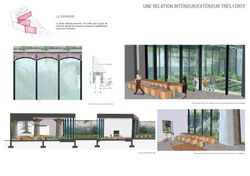
Dans mon projet, la relation intérieure/extérieure est affirmée. La grande verrière permet de proposer un espace complètement ouvert sur le dehors. Et malgré cette limite, les plantes se propagent à l’intérieur et empiètent sur la circulation pour poursuivre le lien avec l’extérieur avec quatre types de plantations différentes.
Cette relation intérieure/extérieure se fait aussi par le parcours lui-même qui passe par l’extérieur. Ainsi, les enfants deviennent acteurs de l’agriculture urbaine dans l’idée d’un apprentissage se faisant en deux étapes : avec de la théorie et surtout de la pratique.
A kitchen-canteen on the “Petite Ceinture”, in Paris (2015)
Interior architecture
The site to invest was a part of the “Petite Ceinture” to the Buttes Chaumont in Paris. The idea was to highlight this exceptional abandoned area with a project made for the children in a fun and educational approach in order to promote urban farming to young people.
The idea would be to create a separate building in distinct steps to represent the process of urban farming. There is a space for garden equipment, a space for crops, a kitchen and a canteen.
In my project, the indoor/outdoor relationship is affirmed. The large glass wall offers a completely open space. And despite this limit, the plants stretch inside and encroach upon the traffic to continue the link with the outside with four different types of plantations.
This inside/outside relationship is also made by the process itself which passes by the outside. In this way, children become participants of the urban farming with the idea of learning in two steps: the theory and especially the practice.